Our food · Where it comes from
Rescued, sorted, handed over.
Almost everything we give out is surplus: good food that was already grown, already picked and already on its way to being thrown out. We collect it, we sort it by hand, and we hand it to families a day or two later.
Who supplies it
Three organizations, one network.
We do not buy produce and we do not grow it. It reaches us through food recovery organizations that collect surplus from wholesalers, growers and grocers across Los Angeles County. These are the three that supplied our September 12 distribution.
Social Justice Learning Institute
Inglewood
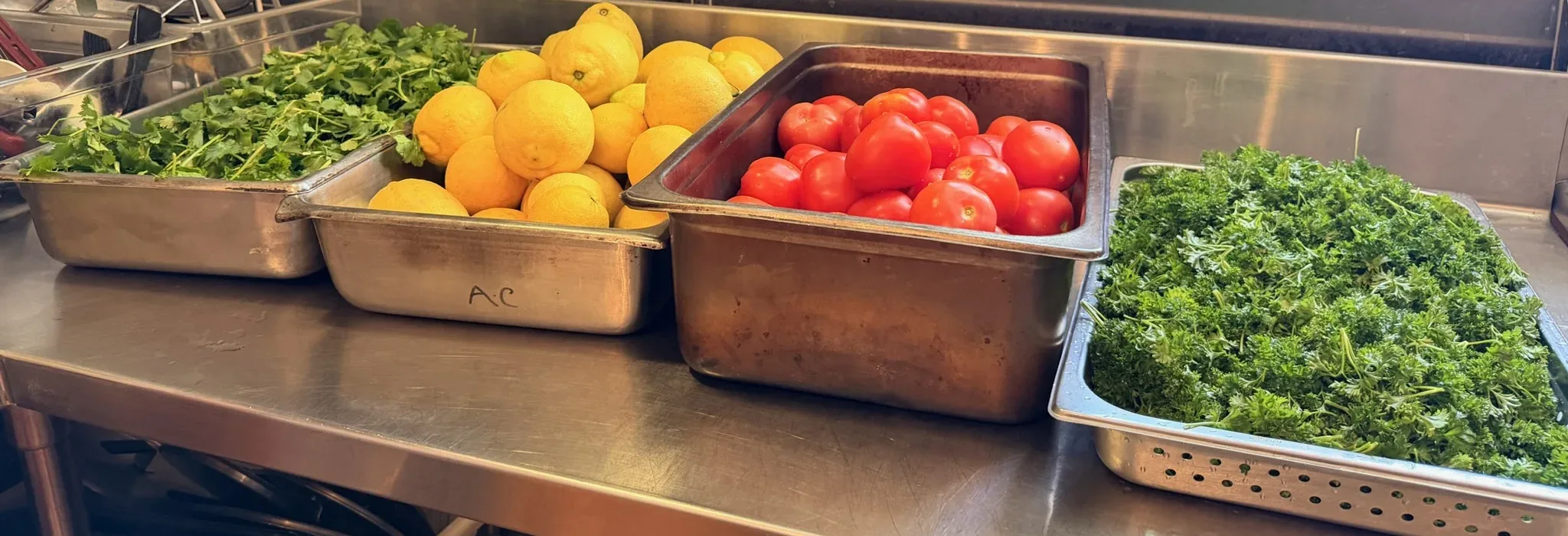
Our steadiest source. They run a produce hub on Friday mornings and we collect a load most weeks. What is in it changes every time: tomatoes, peppers, lettuces, bok choy, squash, cucumbers, greens and whatever fruit came through.
Hollywood Food Coalition
Glassell Park
A food recovery organization that has been feeding people in Los Angeles for four decades. They pass on surplus produce that would otherwise be thrown away, and supplied part of our October giveaway.
Seeds of Hope
South Los Angeles
One of the larger produce networks in the county. We collected from their South LA hub for the first time in June 2026, and they have supplied part of every giveaway since September.
We are also an approved partner of FoodCycle LA, which gives us access to surplus food donations across California. We take only what we can move quickly, for the reasons below. Trader Joe's provided the bags for the September 12 distribution.
How it reaches you
From a loading dock to your hands in about two days.
01
We collect
Most weeks that means a Friday morning run to Inglewood, and before a distribution it means several runs across the county. We do not know what we are getting until we see it. The load is whatever came in that week.
02
We sort
The evening before every distribution, volunteers open every box, pull out anything past its best, and pack the rest into bags by hand. This is the difference between handing somebody a sack of whatever came off the truck and handing them a bag somebody actually looked at.
03
We hand it over
Free, to anyone who comes. No cost, no appointment and no ID required. On September 12 that was 253 bags to 253 families and roughly 1,300 pounds of produce in three hours.
Quality
Every bag gets looked at.
Rescued produce is rescued for a reason. Some of it is cosmetically imperfect, some of it was overstocked, and some of it is simply close to the end of its shelf life. Almost all of it is perfectly good, and a little of it is not.
Sorting by hand is how we tell the difference. Anything we would not take home ourselves does not go in a bag. That is the whole of our quality control, and it is done by volunteers rather than by inspectors, which is why we say so here rather than implying something more formal.
We run no warehouse and no refrigerated storage. Produce is collected in the days before a distribution and goes out within a day or two of reaching us. Nothing sits. We hand out fruit and vegetables whole and unprocessed, in the state they arrived.
What we cannot promise
Worth saying plainly.
We cannot tell you in advance what will be in the bag. We find out the same week you do, and a distribution built on rescued food is built on whatever was rescued.
We cannot guarantee there will be enough. On September 12 everything was gone more than an hour before our posted finish. If you are coming for groceries, come at the start.
All donated produce is distributed as is. Our Food Donation Distribution Policy sets out the limits of our liability as a distributor of donated food, and a copy of the notice is posted at the distribution table at every event. Please look over what you take before you eat it, the same way you would with anything from a store.
Next steps
Come and get some, or help us sort it.
The sorting shift the night before a distribution is the one that decides how good the bags are. It is also the one we most often need hands for.